Something big just shifted in the Gulf
If you live or work in the Gulf, you already know the mood has changed this year. For a long time, the GCC countries — Saudi Arabia, the UAE, Qatar, Kuwait, Bahrain, and Oman — were seen as calm, safe, and always open for business. Oil kept flowing. Gas kept flowing. Projects kept getting built. Life was steady.
That steadiness took a real hit in early 2026.
On 28 February, the United States and Israel launched heavy strikes on Iran. Iran hit back, but not at America and Israel directly — it could not reach them the same way. Instead, Iran aimed its drones and missiles at the oil and gas facilities of the GCC. Things that took years, sometimes decades, to build started getting damaged in a matter of days.
By the end of March, the International Energy Agency said around 40 energy assets across nine countries had been seriously hit. Ships almost stopped moving through the Strait of Hormuz. Oil prices jumped. Qatar had to tell some of its biggest buyers that it simply could not deliver the gas it had promised.
A two-week ceasefire came on 8 April. It gave everyone a moment to breathe. But the damage on the ground was already very real and a huge rebuilding job is in vicinity.
To understand about the rebuilding job and to understand why it is such a big deal, we first need to talk —about what an oil and gas project actually is.
So, what is an “oil and gas project”?
A project just means a piece of work. But in this industry, the word has a specific meaning.
A project is a temporary effort. It has a start date and an end date. A team is put together, money is set aside, and everyone works to build one specific thing — like a refinery, or an LNG plant, or a long pipeline. When it is done, the team breaks up and moves on to the next one.
Two things make oil and gas projects special:
• Each project is different. You are not making the same item again and again like a factory would. Every refinery is unique.
• They are complicated. Oil and gas plants use hazardous materials at high pressures and temperatures, so safety, quality, and planning have to be very, very tight.
That is why these projects are built by large, experienced teams — not one person, not one small firm.
The three main people on any project
On almost every oil and gas project, you will find three key players:
The Owner — The company that needs the facility and pays for it. Think Saudi Aramco, ADNOC, QatarEnergy, or Bapco. They decide what to build and why.
The Designer (also called the Consultant or A/E) — The engineering firm that turns the owner’s idea into real drawings and specifications. Firms like Worley, KBR, Fluor, or Wood are examples.
The Contractor — The company that actually builds the thing. In the Gulf, names like Technip Energies, Chiyoda, Saipem, McDermott, and Consolidated Contractors Company (CCC) come up again and again.
Beneath these three, you have hundreds of smaller subcontractors and vendors. They supply the pumps, valves, compressors, steel, electrical systems, and everything else. When a big project starts, the whole group gets busy.
The three sides of the oil and gas industry
Oil and gas moves through three stages. You will hear these words a lot, so it is worth knowing them:
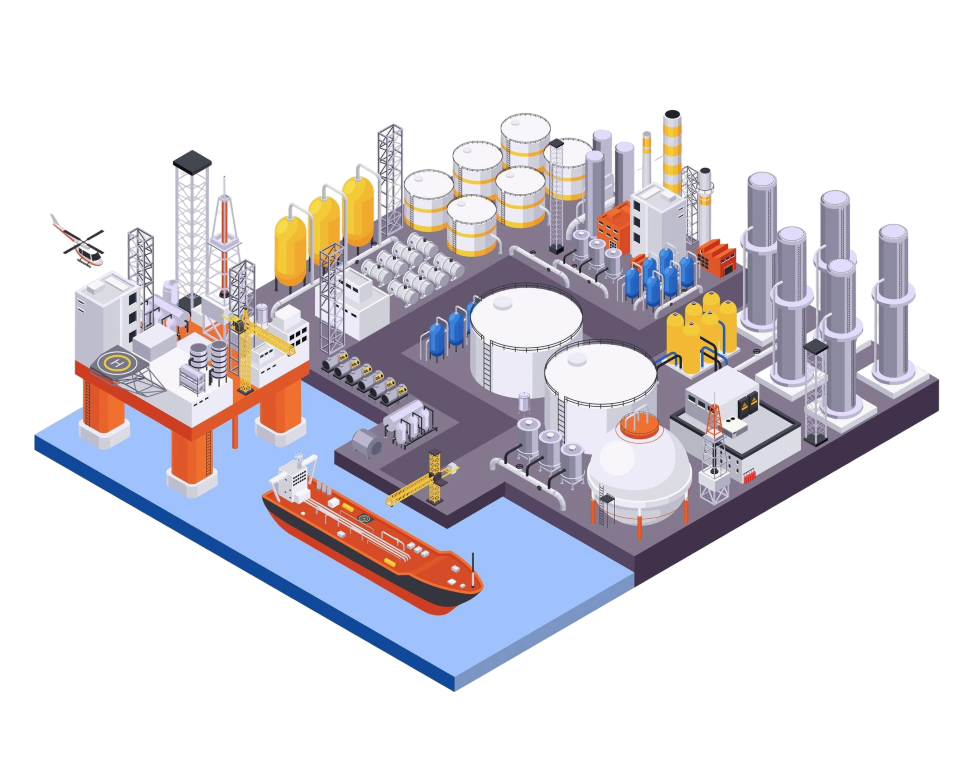
Upstream — Finding oil and gas and getting it out of the ground. This is the world of drilling rigs, offshore platforms, and wellheads.
Midstream — Moving it and storing it. Pipelines, LNG plants, gas treatment, storage tanks, and export terminals all belong here.
Downstream — Turning it into usable products. Refineries make diesel, petrol, jet fuel, and the base chemicals for plastics. This is also where marketing and fuel stations sit.
Here is the important part: the 2026 attacks hit all three sides. Upstream fields, midstream pipelines and LNG plants, downstream refineries — nothing was spared. Which means the rebuilding work is not just in one place or one type of project. It is everywhere.
What got damaged
Here is a simple list of the big hits, based on public reports. You do not need to memorize all the names — just notice how wide the damage is.
Saudi Arabia
• Ras Tanura refinery — the biggest refinery in the Kingdom. Hit on 2 March. It was closed for 16 days and has since restarted.
• Samref refinery in Yanbu — hit on 19 March.
• Satorp refinery in Jubail — one of the largest in the world, damaged.
• Manifa and Khurais fields — major upstream production sites, hit.
• East–West pipeline — pumping stations damaged; capacity has been partly restored.
• Juaymah gas processing plants — damaged, affecting LPG exports.
Qatar
Qatar took the hardest hit. Two LNG trains at Ras Laffan — Trains 4 and 6 — were destroyed. That is about 17% of Qatar’s total LNG output, gone from the market for the next three to five years. QatarEnergy says rebuilding could cost around $26 billion. The Pearl gas-to-liquids plant was also targeted.
UAE
Oil and gas sites in Abu Dhabi and the Fujairah terminal — a key backup route that avoids the Strait of Hormuz — were damaged.
Bahrain
The Bapco refinery on Sitra Island was struck on 9 March.
Add it all up, and the consultancy Rystad Energy estimates total repair costs could land somewhere between $34 billion and $58 billion. That is not a small fix. That is a decade of construction work.
Why this is actually an opportunity
It may feel strange to call a war an opportunity. It is a tragedy first. But for the engineers, project managers, and companies who build energy facilities, the truth is that a massive amount of work is coming.
Here is what the rebuilding wave will need:
• Engineers to redesign damaged units and update old drawings.
• Long-lead equipment like gas turbines, compressors, and heat exchangers — some of these take two to four years to deliver, so orders are already being placed.
• Big EPC contractors to run the work on site.
• Fabrication yards to build modules, pipe spools, and pressure vessels.
• Quality and safety professionals — inspectors, QA/QC engineers, third-party auditors.
• HSE specialists, because process plants are dangerous places and nothing can be rushed.
Japanese contractor Chiyoda, which built many of the original LNG trains in Qatar, has already said it will go back to work at Ras Laffan. Its share price jumped on the news. Analysts expect Technip Energies, Saipem, McDermott, CCC, and Korean and Chinese contractors to lead much of the rest.
There is one catch worth knowing. A lot of the same engineers, yards, and equipment needed for rebuilding are already booked on other big projects — especially Qatar’s North Field expansion. Rystad Energy calls this “a competition for access.” Simply put: whoever signs contracts and places orders early will get the teams. Whoever waits will be stuck in the queue.
Why quality management matters more than ever
This is where the subject of the original book — quality management in oil and gas projects — becomes very real.
When you are under pressure to rebuild fast, the temptation is always to cut corners. Skip an inspection. Approve a vendor without enough checks. Let a weld slip through. But in process industries, a small quality mistake can turn into a very big safety problem. A failed weld is not just a broken pipe — it can mean a fire, an explosion, or worse.
A few reminders that matter right now:
• Owners cannot hand off quality to the contractor and forget about it. The owner’s team has to stay involved from start to finish.
• Vendor quality matters just as much as site quality. If a valve, pump, or piece of pipe is bad, it does not matter how good your welders are.
• Quality and safety are the same conversation. You cannot have one without the other.
• Documentation is part of the job. Photos, inspection records, material certificates — all of it needs to be complete so audits and insurance claims work later on.
Take-away
The Gulf is going through something it has not seen before. The attacks have shown how much of the world’s energy sits in one small region, and how quickly things can be damaged. But they have also shown something else — that the GCC has the money, the experience, and the workforce to rebuild, and to rebuild well.
For anyone working in or studying the oil and gas industry in the Gulf, my honest advice is this: take it seriously, and get ready. Learn your project management. Learn your quality systems. Understand how upstream, midstream, and downstream differ. Pay attention to who is winning the big contracts, and why.
The next ten years of Gulf energy are going to be written on construction sites. A lot of good careers will be built on those sites too.
Sources: Middle East Council on Global Affairs, Rystad Energy, Wood Mackenzie, Reuters, The National, World Economic Forum, and the International Energy Agency.

